


Bosch dishwashers are famously reliable, but even the best machines throw an error now and then. When they do, the display shows an “E” followed by numbers—E15, E24, E09, and so on. These codes are not random; they’re diagnostic hints about where to look first. This guide explains what the most common codes usually mean, simple checks you can do at home, and how to prevent the same problem from returning. We’ll also flag the moments when DIY stops being smart and professional help becomes the safer, cheaper long-term move.
Quick note: Code meanings can vary slightly by model and region. Always compare our tips with your model’s user manual. If anything feels risky, stop and get help.
How to Read & Clear Codes (Before You Start)

- Power cycle safely. Turn the Bosch Dishwashers off, wait 2–3 minutes, then turn it on. Some transient glitches vanish after a restart.
- Try a soft reset (if your model allows it). Select a cycle, hold the Start button for ~3–5 seconds until it resets.
- Check the door. A mislatched door can trigger odd behavior. Close it firmly and re-test.
- Unplug before hands-on. Any inspection near wiring or pumps requires the machine to be unplugged (or the breaker off). Safety first.
If the code returns after a restart, assume it’s real and move to targeted checks.
Water Supply & Inlet Errors
E18 — Not Enough Water / Fill Timeout

What it usually means: Bosch Dishwashers isn’t getting water fast enough.
Likely causes:
- Kinked or crushed inlet hose
- Closed or partially closed supply valve
- Sediment is blocking the little mesh filter at the hose connection
- Low household water pressure
DIY checks:
- Confirm the water valve is fully open.
- Pull the unit forward slightly and make sure the inlet hose isn’t bent sharply.
- Turn off the water, remove the hose at the Bosch dishwasher’s end, and gently rinse the mesh screen.
Call a pro if: The valve hums but no water enters, or the code persists after you’ve verified flow. A faulty inlet valve or control issue may be involved. For fast help, consider Professional Appliance Repair.
E17 — Too Much Water / Overfill

What it usually means: Overfilling was detected—often a stuck inlet valve or sensor misread.
DIY checks:
- Ensure the float (if visible) moves freely and isn’t obstructed by debris.
- Inspect the inlet valve for constant dripping with the machine off (a tell-tale sign it’s stuck open).
Call a pro if: Water continues flowing with the machine off. That’s a hardware issue best handled by a technician.
Leak & Flood Protection
E15 — Leak Detected / Water in Base
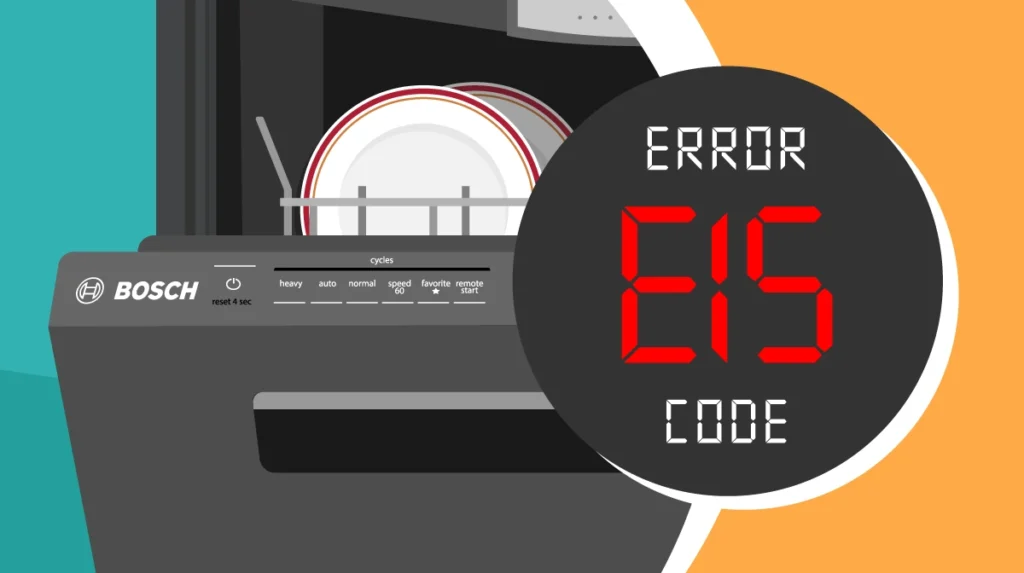
What it usually means: Water has pooled in the base pan and tripped the leak switch.
Common causes:
- Loose hose clamps
- A door gasket is leaking during the spray
- Internal seal failure
- Excessive suds foaming over (wrong detergent)
DIY checks (carefully):
- Check for visible drips beneath the door during a brief test.
- Verify you’re using the right detergent and dose (over-sudsing can mimic leaks).
Avoid internet “tilt tricks.” Some suggest tilting the unit to drain the base; that might mask a real leak and create a mess. It’s safer to locate the source. If you want it fixed properly, explore Dishwasher repair or contact us for guidance.
Drainage & Filter Issues
E22 — Filter Blocked

What it usually means: The fine filter at the bottom is clogged.
DIY fix:
- Remove the lower rack.
- Twist out the filter assembly and rinse thoroughly.
- Wipe the sump area to remove glass, labels, or seeds.
E24 — Drain Hose / Installation Fault

What it usually means: The dishwasher can’t drain properly—often a hose or air-gap issue.
DIY checks:
- Make sure the drain hose forms a high loop under the counter (to prevent backflow).
- If you have an air gap on the sink, pop the cap and clear debris.
- Confirm the garbage disposer knockout plug (for new installs) has been removed.
E25 — Pump Impeller Blocked

What it usually means: Something is obstructing the drain pump impeller (bones, glass, fruit pits).
DIY checks (unplug first):
- Remove the filter.
- Peer into the sump and feel for debris around the pump cover (if your model allows safe access).
- Never force the impeller; if it won’t turn freely, stop.
E23 — Drain Pump Electrical Fault

What it usually means: The pump may have failed electrically, or the wiring is damaged.
DIY or pro? This typically needs a multimeter and experience. It’s usually faster and safer to book an appointment for diagnosis.
Heating & Drying Problems
E09 — Heating Element / Heat Pump Failure

What it usually means: The dishwasher can’t heat water correctly—expect cool washes and poor drying.
Possible causes:
- Heat pump or inline heater failure
- Failed relay on the control board
- Limescale buildup is stressing the element
DIY checks:
- Run a hot cycle and check if the interior door feels warm mid-cycle (careful—steam).
- Descale the machine if you have hard water (use a dishwasher descaler, not straight vinegar).
Call a pro if: You still get E09 after descaling and restarting. Heating circuits run on mains voltage—best left to technicians.
E20 — Heating Circuit / Temperature Sensor Fault (Model-Dependent)

What it usually means: A problem in the heating circuit or NTC temperature sensor.
DIY checks: Limited—beyond cleaning and reset, this is typically a professional test/replace scenario.
Circulation & Flow Sensor Errors
E21 — Circulation Pump Blocked or Stalled

What it usually means: The main wash pump isn’t circulating water effectively.
Symptoms: Noisy wash, poor spray action, incomplete cleaning.
DIY checks:
- Make sure spray arms are clean and spinning freely.
- Check the sump area for broken glass that may jam the pump.
When to call: If the pump hums but won’t move water, it may need replacement.
E14 — Flow Meter / Water Intake Sensor
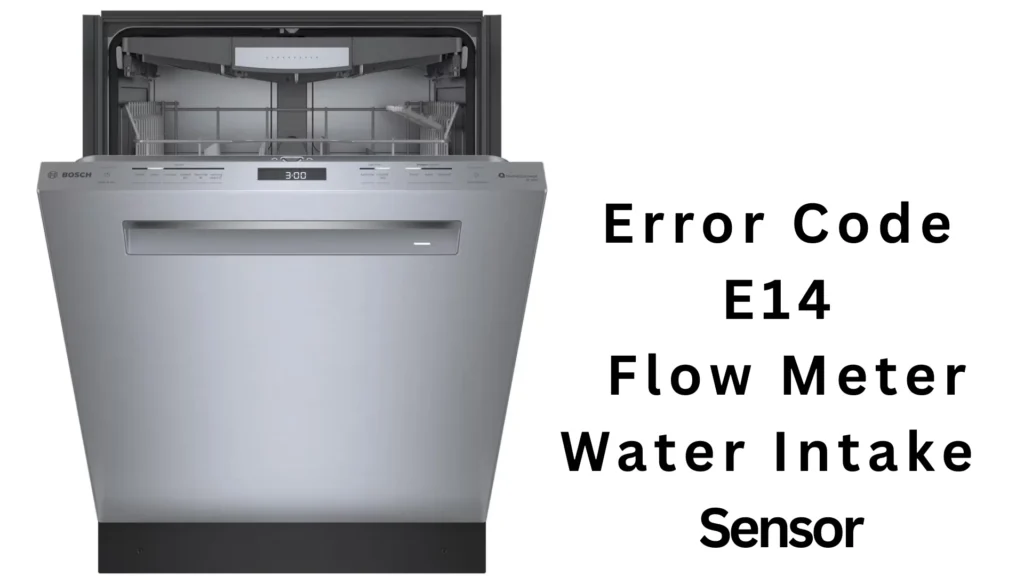
What it usually means: The control can’t accurately measure incoming water flow.
Common triggers: Mineral deposits, restricted inlet, faulty sensor.
DIY checks: Combine E14 steps with E18 checks—clean the inlet screen and ensure good pressure.
E19 — Valve / Heat Exchanger Control (Model-Dependent)

What it usually means: An internal control valve related to the heat exchanger isn’t behaving.
DIY or pro? Typically, pro access is tricky and parts are model-specific.
Power & Installation
E27 — Mains Voltage Too Low / Unstable

What it usually means: The Bosch Dishwashers are seeing voltage outside its expected range.
DIY checks:
- Avoid running on an under-rated extension cord or power strip.
- If the lights dim when the dishwasher starts, consult an electrician.
Practical Prevention: Keep Errors from Returning

- Rinse the filter monthly. It takes 60 seconds and avoids E22/E24 headaches.
- Run your Bosch Dishwashers cleaner every 1–2 months. Helps prevent scale (E09-related stress) and keeps sensors honest.
- Mind your detergent. Use high-quality tabs or powder—avoid hand-dish soap at all costs.
- Load smart. Don’t block the spray arms or the detergent cup.
- Check the loop. Confirm the drain hose still has a high loop after any under-sink work.
- Watch for drips. A small puddle today (E15 tomorrow). Catch leaks early.
When DIY Stops Making Sense

Some fixes—like replacing an inlet valve, diagnosing a drain pump circuit, or swapping a heat pump—require parts, tools, and a bit of nerve. If you’re short on any of those, it’s perfectly reasonable to bring in help:
- Need help right away? Professional Appliance Repair
- Know what time works for you? Book an appointment
- Prefer a quick question first? Contact us
- Focused service for dishwashers: Dishwasher repair
Quick FAQ
Will a reset clear every error?
No. A reset clears temporary glitches but won’t fix a real blockage, leak, or failed component. If the code returns, treat it as real.
Where’s my model number?
Usually on the inner door edge or the tub frame. Having it handy ensures you get the right parts and instructions.
Is vinegar okay for cleaning?
Light use is fine, but dedicated dishwasher cleaners are gentler on seals and better against scale/grease blends. Avoid strong acids or mixing chemicals.
My dishwasher shows no code but isn’t draining. What now?
Start with the filter, air gap, and hose loop. Many drainage issues are purely mechanical and won’t always throw a code.
Bottom Line
Error codes on Bosch Dishwashers are more helpful than scary—they’re clues. Start with simple checks (filter, hose, inlet screen), then move up to component diagnosis. If a leak or high-voltage component is involved, calling a technician often costs less than a misstep. When you’re ready, book an appointment or contact us and get your dishwasher back to its quiet, spotless best.
